Insights
Search through our most active topics and see how they are helping clients discover new potential and implement positive change.
IFRS
TAX
LAWS
International Financial Reporting Standards (IFRS)
The IASB issued IFRS 20 Regulatory Assets and Regulatory Liabilities to replace
IFRS 14 Regulatory Deferral Accounts, a new accounting standard for companies subject to a specific type of rate regulation, it was published on 27 May 2026.
IFRS 20 applies to entities subject to a specific type of rate regulation, arrangements in which a regulator determines how much a company can charge its customers and when those amounts can be charged. This is most common among providers of essential services, including electricity, water, gas, and certain transportation and energy businesses. If your organisation operates under a regulatory agreement of this nature, IFRS 20 is likely to have a direct impact on your financial statements.
Imagine a water company that spends millions fixing pipes this year. The regulator says: "Fine, you can recover that cost, but only by charging customers higher rates next year." Under the old rules, this year's accounts look terrible (big costs, no matching revenue) and next year's look artificially great. The company's real performance is distorted.
IFRS 20 calls this a "difference in timing," and its key principle is that a company should recognize the total allowed compensation for regulatory goods or services in the same period it supplies them. In other words: if you've earned the right to charge customers more later, you book a regulatory asset now. If you've overcharged and owe customers money back through lower future rates, you book a regulatory liability.
IFRS 20 makes regulated utilities' financial statements match economic reality by recording the money they're entitled to collect (or obligated to give back) through future regulated rates, not just what they billed this year.
Important Note -
Although the effective date may appear distant, implementation should not be delayed. Affected entities should begin by identifying regulatory agreements within the scope of the standard, assessing the potential impact on reported results, updating systems and processes, and developing a clear implementation roadmap. Early engagement with auditors, regulators, and investors will help ensure a smooth transition.
Replaces IAS 1. Changes how you present financial performance, not how you measure it. All income and expenses must now be classified into defined categories.
Income & expense categories
+ Operating - Core business income and expenses
The default category — anything not classified elsewhere goes here. It reflects your main business activities.
- Revenue from sales of goods or services
- Cost of goods sold and operating expenses
- Salaries, rent, utilities
- Impairment losses on operating assets
Produces the new mandatory subtotal: Operating profit or loss.
+ Investing - Returns from assets outside core operations
Income and expenses from assets that generate returns independently of main operations.
- Dividends received from equity investments
- Interest earned on loans to third parties
- Gains or losses on disposal of investments
- Share of profit from associates & joint ventures
Assets used daily in operations (e.g. machinery) stay in Operating, not here.
+ Financing - Cost of raising & Servicing capital
Covers costs from liabilities used to raise finance — the cost of borrowing money.
- Interest expense on bank loans and bonds
- Interest on lease liabilities (IFRS 16)
- Gains or losses on early repayment of debt
- Transaction costs on issuing or repaying loans
Trade payables and operating-related liabilities stay in Operating.
+ Discontinued operations - Business being wound down or sold
Results from a business segment disposed of or held for sale — keeps ongoing performance separate from one-off exits.
- All income & expenses of the discontinued segment
- Gain or loss on disposal of the segment
- Re-measurement to fair value less costs to sell
Shown as a single line on the income statement; detail disclosed in the notes.
Important Note - Comparative 2026 figures must be restated - businesses should begin preparation now.
Requires almost all leases to appear on the balance sheet as an asset and a liability, bringing hidden obligations into the open.
What changes on your financial position
> Right-of-use asset
When you sign a lease, you record an asset representing your right to use that item - office, vehicle, equipment. It is depreciated over the lease term.
> Lease liability
The present value of all future lease payments, recorded as a financial obligation. Interest expense is recognised separately each period.
Practical exemptions
Short-term leases — 12 months or less
Low-value assets — e.g. laptops, small office equipment
Putting leases on financial position increases reported debt, which can affect loan covenants and credit ratings. Review your leasing agreements now.
Governs when and how much revenue to recognise. Replaces IAS 11 & IAS 18 with a single, consistent 5-step model that applies to virtually every business selling goods or services.
The 5-step revenue recognition model:
- Step 1 — Identify the contract
Written, oral or implied agreements that create enforceable rights and obligations between both parties.
- Step 2 — Identify performance obligations
Break the contract into distinct promises. A product bundled with a warranty may be two separate obligations.
- Step 3 — Determine the transaction price
Total amount expected to be received, including estimates for variable elements like bonuses or discounts.
- Step 4 — Allocate price to each obligation
Split the price between obligations based on their standalone selling prices.
- Step 5 — Recognise revenue when obligation is satisfied
At a point in time (goods delivery) or over time (services, construction contracts).
Bahrain TAX & Value Added Tax (VAT)
Electronic invoicing is being introduced across the Gulf as tax authorities move toward digital, data-driven VAT administration. Saudi Arabia implemented its framework first, the UAE and Oman have since confirmed their own phased rollouts, and Bahrain is progressing along a similar path.
What e-invoicing means
E-invoicing is not simply sending an invoice as a PDF. It refers to issuing invoices in a structured, machine-readable format that can be transmitted to, or validated by, the tax authority’s systems. In a clearance model, an invoice is submitted for validation before or shortly after issuance, and is only treated as a valid tax invoice once it passes.
The position in Bahrain
The National Bureau for Revenue (NBR) is the authority responsible for VAT in Bahrain and is leading the development of the e-invoicing framework. Over recent years the NBR has reviewed the supporting legal framework, tendered for a central platform to receive and validate invoice data, and consulted with businesses on invoicing volumes and technical standards.
Market expectation is that any mandate will be introduced in phases, beginning with larger taxpayers and extending over time to the wider VAT-registered population. However, no confirmed implementation timeline has been officially published at the time of writing, and businesses should treat NBR announcements as the only authoritative source on dates and scope.
Separately, VAT-registered persons in Bahrain are already permitted to issue and retain invoices in electronic form without obtaining prior approval from the NBR.
Existing invoicing obligations
Irrespective of e-invoicing, Bahrain’s VAT legislation already requires a VAT-registered person to issue a tax invoice for taxable supplies, containing prescribed particulars including the VAT account number, invoice date, taxable amount, and the VAT rate and amount. Invoices and related records must be retained for the period specified in the VAT legislation and made available to the NBR on request.
Practical steps businesses can take now
Preparation for e-invoicing is largely a matter of data and process quality, and each of the following is worthwhile regardless of the eventual timeline:
- Ensure customer and supplier master records are complete and accurate, including valid VAT account numbers and correct legal names.
- Review a sample of issued invoices against the mandatory tax invoice particulars set out in the VAT legislation.
- Confirm whether your accounting system can produce invoice data in a structured format, and ask your software provider about its Bahrain e-invoicing roadmap.
- Identify any invoices or credit notes raised outside the main accounting system, and bring them into a controlled process.
- Reconcile the invoice ledger to the VAT return so that reported figures can be traced to underlying documents.
Further information
The NBR publishes guidance and announcements relating to VAT and e-invoicing on its official website.
The 2025–2026 budget approved in March 2025 outlined plans to implement a broad corporate tax, and the upcoming Bahrain CIT is expected to include specific provisions related to capital gains tax and transitional rules.
On 29 December 2025, the Bahraini Cabinet approved the introduction of Corporate Income Tax (“CIT”) in Bahrain, with implementation anticipated from 2027. Based on the Cabinet’s announcement, Bahrain is expected to introduce a 10% CIT applicable to businesses that meet either of the following thresholds:
- Annual revenues exceeding BHD 1 million, or
- Net annual profits exceeding BHD 200,000.
What is CIT?
Corporate Income Tax (CIT) is a direct tax levied on taxable income earned by a taxable person during a financial year. CIT is generally assessed through an annual tax return and may be subject to audit by the tax authority. In Bahrain, taxable persons could include companies, establishments, branches of foreign entities, and individuals whether or not commercially registered-who are considered to be carrying on a business.
Capital gains on the disposal of assets are expected to be taxable, with potential exemptions subject to meeting conditions (for example, group restructuring). Transitional provisions should prevent taxation of gains generated prior to CIT go-live.
Alert >> With CIT on the horizon, businesses should act in three phases: first, assess the impact on your current structure, operations, and related-party transactions; then, once regulations are released, address transitional rules, tax accounting adjustments, and ERP readiness; and finally, get your administration in order, covering tax registration, filing processes, transfer pricing documentation, and audit preparedness.
Bahrain Regulatory General Topics
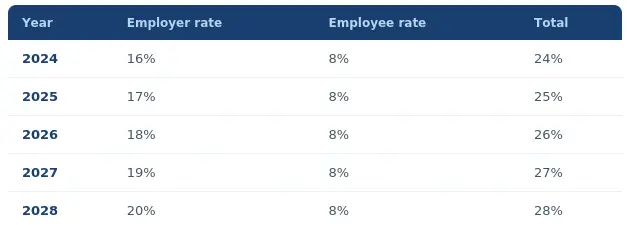
Law No. (14) of 2022 amended Bahrain's Social Insurance Law (Decree-Law No. 24 of 1976), introducing mandatory annual 1% increases to employer contributions from 2023 to 2028, aiming to improve long-term sustainability. Key reforms include increasing employer contributions to 17% in 2025 and 18% in 2026 for Bahraini workers, while employee contributions remained unchanged at 8% (inclusive of 1% unemployment insurance).
Contribution schedule:
Bahrain Edict No. 109 of 2023, issued by the Prime Minister in December 2023, establishes a new end-of-service gratuity system for non-Bahraini workers in the private sector. It requires employers to remit gratuity contributions to the Social Insurance Organisation (SIO) monthly rather than paying them directly upon termination, effective March 1, 2024.
Monthly contribution rates
:
- First three years of service 4.2% of monthly wage (~½ month's wage per year).
- Each year beyond 3 years 8.4% of monthly wage (~1 month's wage per year).
Note - EOSB accrued before 1 March 2024 remains the employer's direct responsibility, to be paid upon termination in the traditional way.